Ground Under Repair

In all the time I readied my new camera for Calder’s Teodelapio, I never imagined this. (Ground under repair belongs on the links.)

Did Calder ever anticipate this mess either, do you imagine? Surely a sculptor with his technological mastery must have known.

That someday it would come to this. Asphalt stinks when it’s poured. And it crumbles under the pounding of cars, the fissures of ice.

How much of the artistic genius in a monumental sculpture comes from the industrial materials and the technological mechanics of it?

Damned if I know. Walter Benjamin wrote “The Work of Art in the Age of Mechanical Reproduction.”  Or so I’ve been told.

The issue I asked myself, coming out of the station when we arrived, was much simpler: Is the construction scene funny or sad?

Neither, I suppose, is the pragmatic answer. Both, the measure of a mood swing. Only what have they done with my photo op?

According to the rules of golf, I would get a free drop. But where do I place myself and remain while moving no closer to the hole?

Surely, that now is the focal point of the shot? Not the steadfast monument to art, long standing and still to be. But the makeshift work.

“Ground under repair” says it all. And so, while I shall be heading off soon to test my eye, I leave an assignment if you like to play.

Get your bearings with this collection of last year’s shots. When you are ready, compose your photo of the ground beneath his feat.

Colloquio Spoletino

ArtInTheCity (2)

Reb:  Am I just a dim-wit, or is that sculpture new?

JT:      ________________.

So how would you fill in the blank spot in this dialogue?  Probably depends on your reading of the wattage on my dome.

With an eye toward more educational pursuits, I search the net.  Romance languages return us to where the colloquio started:

a) talk; b) meeting; c) conference; d) interview; e) dialogue; f) discourse; g) consultation; h) deliberations; i) colloquy

The “Spoleto” to “Spoletino” construct is familiar enough as well.  The location of “Sculptures in the City” (from 1962), we are learning, is not.

We know these figures by Pietro Consagra from the town museum (memory gets a jog), yet they were originally on top of the steps we just talked our way down.

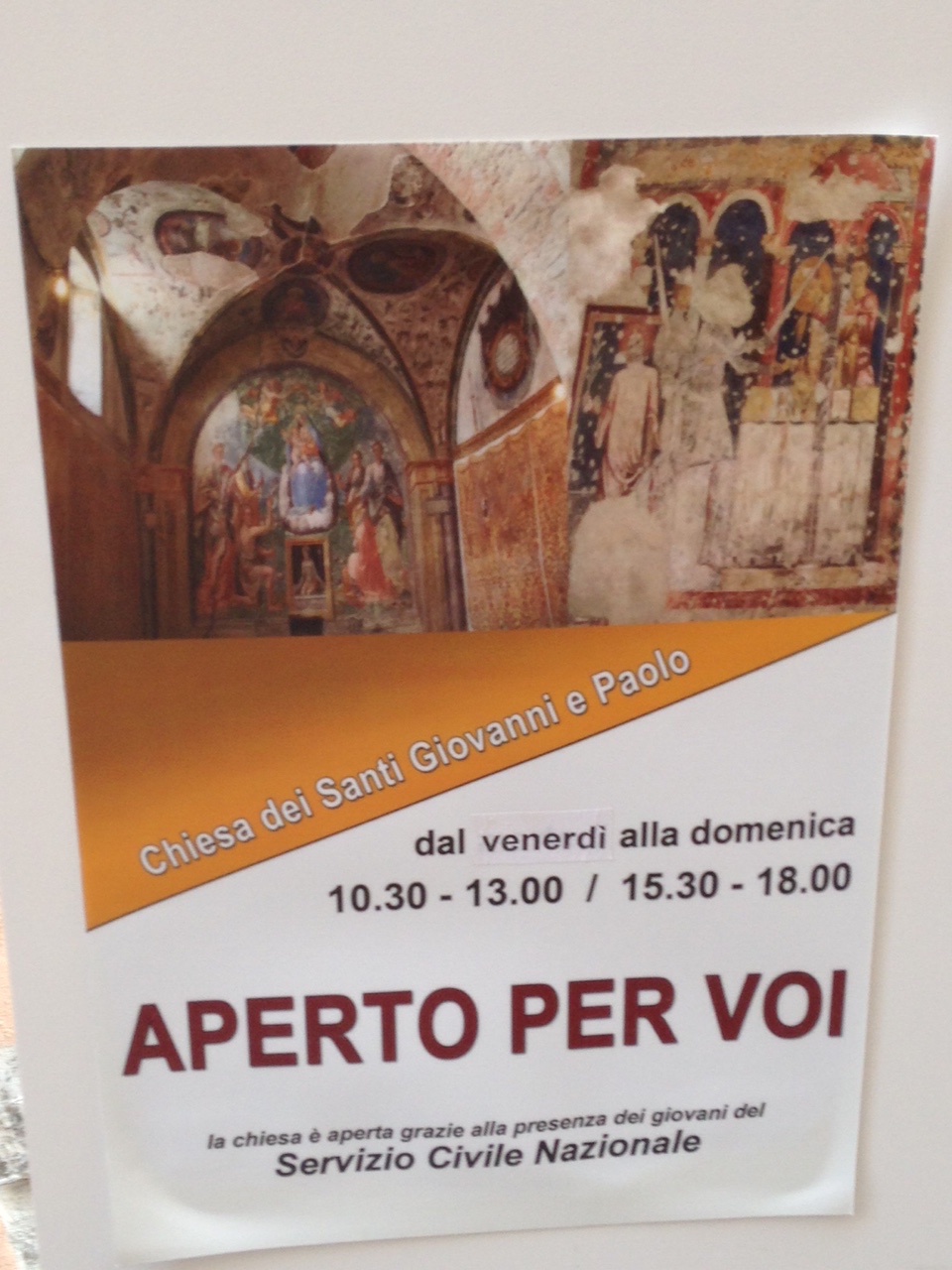
Aperto Per Voi

I’ll say! In Italian, or in translation (“Open for you”). Truer words were never spoken.

Wiki Loves Monuments.  (As do I.)  La Chiesa dei Santi Giovanni e Paolo is one of my favorites.

So today, when Rebecca and I snapped this photograph, we couldn’t have been more excited.

ApertoPerVoi copy

We have a date: between Friday and Sunday, at the appointed hours, finally to see it from inside!

Meanwhile, I have homework: either to find the English version or to translate this webpage on my own.

Opening Farewell

By the time we are meant to leave our little town, the sweltering heat will be gone and this window will be closed.

Rebecca says as much, half-marveling and half-grieving the passage, as she wonders what moved me to shoot it.

Even if I knew, I might not say to her or U. The artist rightly holds her tongue, letting the brush do its work (or not).

Yes, but the novelist can’t help himself. (Just a girl’s muddy drawers sets Faulkner’s imagination off on The Sound and the Fury.)

Between two aesthetic theories falls the shadow of the absent owner at Osteria del Trivio. A night off? Or intimations of mortality?

On the way to the art store earlier today, I composed an album of shop fronts: mostly vacant, a few newly opened in the intervening year.

Of time and the river, they sing (like Jackson Browne?). Then might it be said (about “19”), so much always depends on the frame?

Brief Encounters

But one of several pastimes, our Italian lessons catch the accomplished ear of the young guy at the table beside us.

He’s been typing feverishly (writing what I wonder?), when suddenly he breaks off to ask, “Going or coming?”

Huh, is the first sound thing that trips through an addled brain. Next, the voice of Father Guido Sarducci on Saturday Night Live.

Luckily, I manage to refrain from speaking either of these non sequiturs. Instead, “Just arriving” sends us off on a quick set of Italian vocabulary lessons, some hesitant geography, and a few tasty morsels of his biography.

Dual-citizen. Exeter year abroad. Now grinding away in Med School. With summer breaks in a little Italian town, whose name on his tongue our ears muffle. (With a little help from a map, we trust, triangulation will find it.)

A flurry of good feelings, with well wishes at the close. He, back to his keyboard. We, back to our bored games. Happy campers one and all.

<Later on, Sunday night>

Politically Incorrect

In the war on jet lag, sleep at 20:00 is the enemy. So we occupy a spot, long after dinner, in Aeroporto di Roma.

Bored games help. Nationality Profiling, a politically incorrect update of the classic Clue, keeps us smiling.

<Sunday night>

Flight Flicks

No reputable critic recognizes or touts this genre, so far as I know. But I go for movies of a certain type for part of the time, while stuck in a cabin over the Atlantic.

Last year, it was Draft Day. This year, The Longest Ride. Both, to my mind, are slight films at best, probably much worse. Never a temptation in first run.

So what’s the attraction? This elective affinity between slight movies and long flights? A comic rhyme, or ironic reflection of the expense of time in a waste of shame?

I leave the question to philosophers and film critics, as I turn an eye to more weighty stuff: yet another remake of Far From the Madding Crowd. My Hardy in Cliff Notes yet again!

<Saturday night: 11:00PM>

This is the way two novels (and one quick trip) end

Portrait of the Artist as a Young Man:

APRIL 26. Mother is putting my new secondhand clothes in order. She prays now, she says, that I may learn in my own life and away from home and friends what the heart is and what it feels. Amen. So be it. Welcome, O life, I go to encounter for the millionth time the reality of experience and to forge in the smithy of my soul the uncreated conscience of my race.

APRIL 27. Old father, old artificer, stand me now and ever in good stead.

Dublin, 1904

Trieste, 1914

TriesteJoycePlaque

Ulysses

… and then he asked me would I yes to say yes my mountain flower and first I put my arms around him yes and drew him down to me so he could feel my breasts all perfume yes and his heart was going like mad and yes I said yes I will Yes.

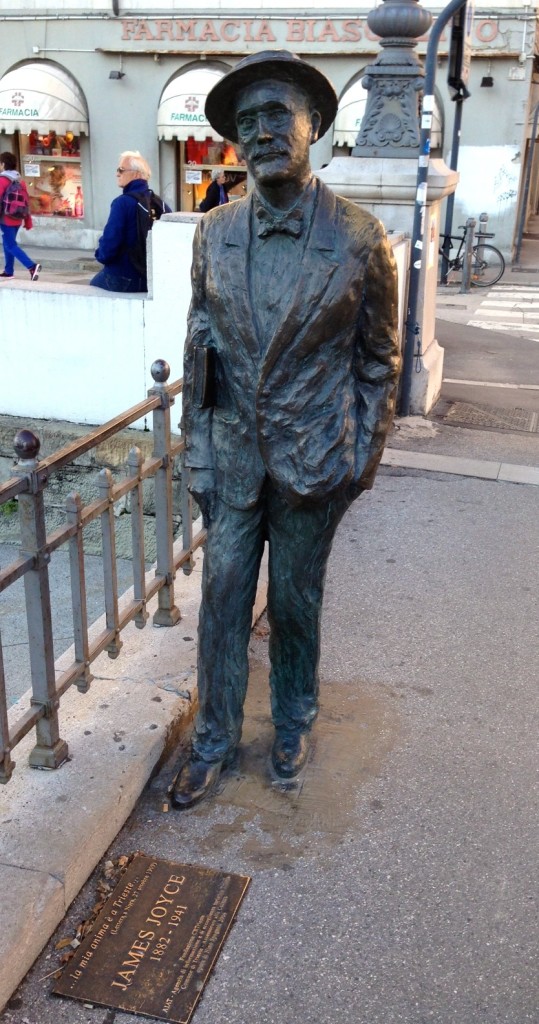
Trieste-Zurich-Paris 1914-1921

TriesteJoyce