Coquette

Rebecca is going to have to stop singing Quando Men Vo from La Boheme.

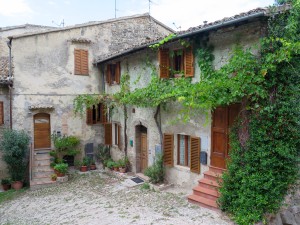
First, it was with Italian men, like that cute little five-year old yesterday morning, winking back and forth without a single qualm.

Now it’s with Italian women, like that young apprentice at the fruita e verdure, each exchanging laughs over every nuance of translation.

Walled Up

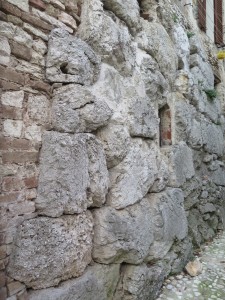
Remains of a Roman fortification can be seen alongside Via Mura Ciclopiche.

I’m still working to decipher the meaning of the name for the pathway.  (One answer I’ve seen invokes Greek myth; the other says it’s so-named because it follows the line of a fortified road that ran along the outside of the walls. Reason fails me.)

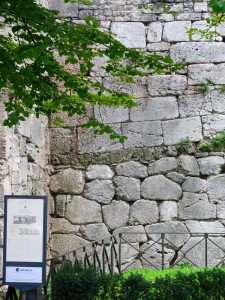
Elsewhere, another stretch of wall readily displays three phases of construction.

The irregular blocks are pre-Roman (4th century BC).  The squared limestone blocks are from the Roman colony (c. 241 BC).  And the unseen section, parts of the restored walls after Sulla (82 BC) and the earthquake (63 BC) remodeled.

The House on the Hill

Or else, the fool can’t stop shooting off his mouth with pixels?

Open Art Spoleto

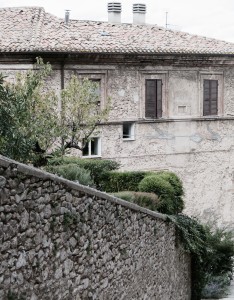
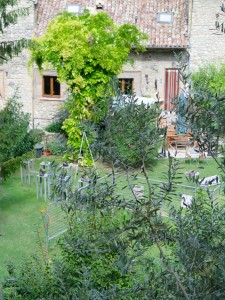
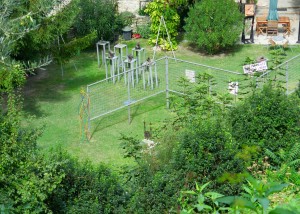
Two different views of the garden, on an earlier day’s outing, from above:

The widest angle, by far, on the house.  Of note from an earlier post: to enter the garden, you step right off the walk beside the Roman wall (Via Mura Ciclopiche).

Second Chance

Venture down the steps below the Duomo to feel the magic of an unusual and enchanting garden surrounded by medieval houses.  There is a likely chance you will meet the artist.  It surely will be a highlight of your visit to Spoleto.

Unsure who wrote these words, sitting invitingly on the flip side of the Open Art Spoleto brochure.  But they capture the feeling we’ve had each time we visited.

With one exception: the chance of finding it open, much less meeting the artist,  never seemed all that likely.  (Many photographs we have, certainly, from afar.)

This year, all that changed.  After pulling on the locked gate, hearing the hidden dog bark, we turned to leave … before an English-speaking Italian appeared.

He fumbled through a set of keys; joked about the last one holding the charm; then ushered us into a truly enchanting garden surrounded by medieval houses.

The brochure forgot to mention all the art works, spread throughout the garden, in the open air.  Small sculptures, mostly figures and faces, hanging everywhere.

Some of these photos online, from a garden party, come close to the feel (if you subtract the important-looking people and flip the setting from night to day).

Predictably, neither the brochure nor the website carries any of the delight of the conversation.  Born in Spoleto, Giampiero Panella returned home ten years ago.

He lives and works in this fabulous old house, realizing the human form in terra-cotta figures, then converted to bronze before being placed in a garden setting.

<The Machine in the Garden is an old book of mine.  After my fall from grace with technology, I fear promises.  If some of the pixels turn out, you’ll see.>

Chance Encounters (of the delightful kind)

Two chance encounters, one yesterday and one this morning.

Both prove utterly delightful, each in their own peculiar way.

In the first, a couple from Pittsburgh get off the Rome train.

Before long, they spot an American by the photos he takes.

It turns out they are on a pilgrimage to a family homestead:

Spoleto, for her; an unheard/unfamiliar town or region, for him.

Each in a day’s journey from Rome to see what they could find.

She carried a photograph; he, a complete set of Italian passports.

Stories shared.  Directions given.  Finally, best wishes extended.

Unknowns encountered on both sides: a chance meeting we keep.

Lesson Plans

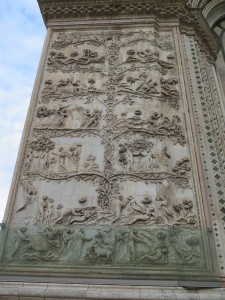
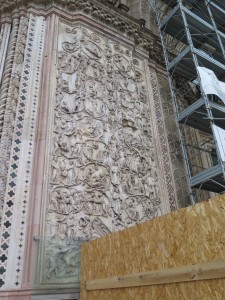
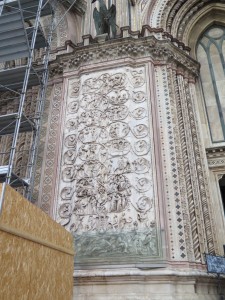
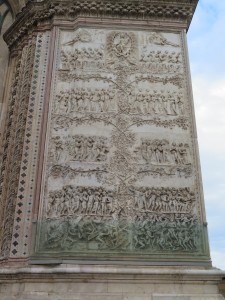
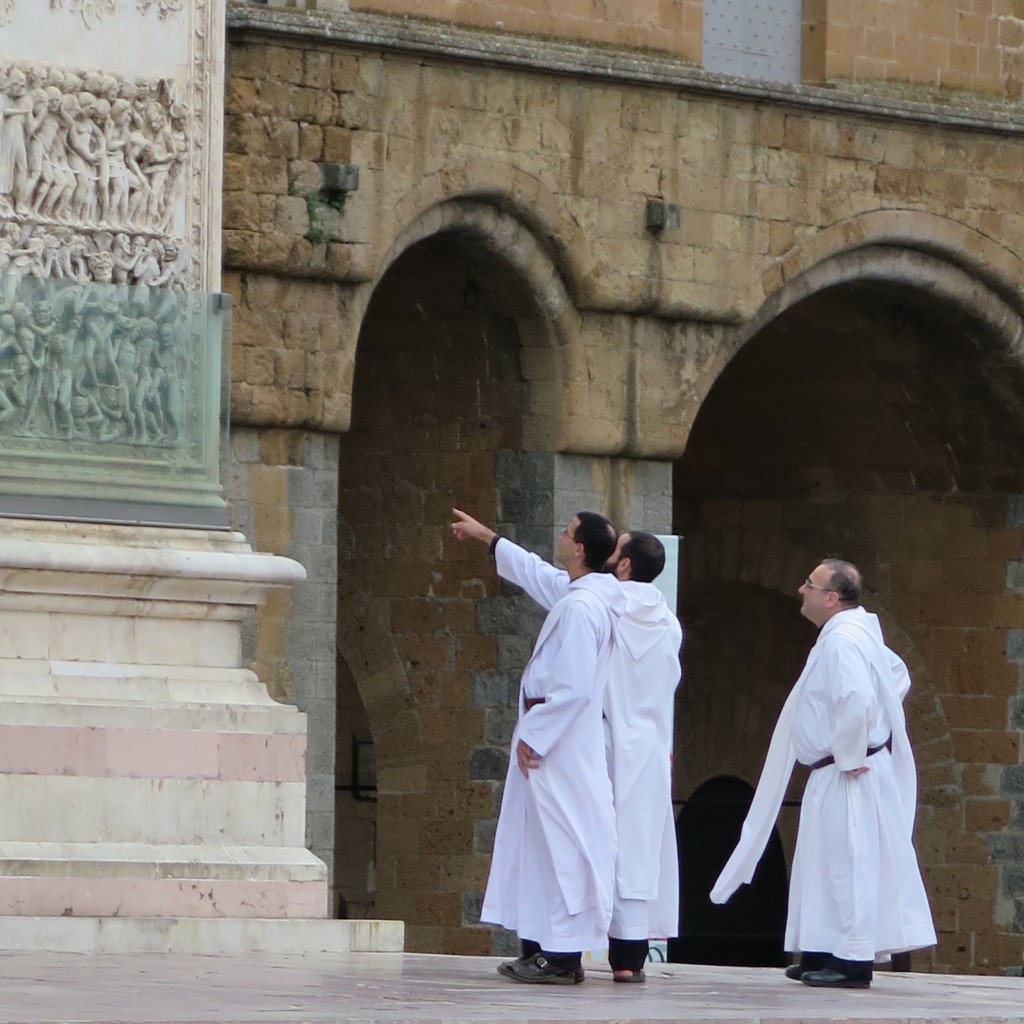
I was preparing to explain about the four bas reliefs (from the 13th and 14th centuries) on the facade to the Duomo in Orvieto.

But then one better qualified appeared to expound on the Last Judgment.

Meanwhile, Back in Orvieto

Churches, churches everywhere.  Two of our favorites:

For those in the historical know, the portico on the left is a 15th-century addition.  And for those in the mathematical know, that’s a dodecagonal bell tower.  (Twelve sided, my internet dictionary tells me.)  Further, there was much written about the underground spaces from Etruscan and medieval periods. Never found them.

On the outskirts of the town, close to where it drops straight down, an old church.

This one was built at the beginning of the 11th century (in a Romanesque style, as if I could tell the difference between this and the “Romanesque Gothic style” of Chiesa di Sant’ Andrea.  Suffice it to say, cramming for tests in “Humanities” is no guarantee of long-term memory, much less life-long learning.  Nothing beats being there, soaking it all in–to the point that you are overwhelmed with a sense of the past, the long duration, in decided contrast to the short history of the U.S.)

Images Missing in Action

Like Julia Randall’s sonata, we keep repeating ourselves with no qualm.  (In the case of our Anniversary celebration in Spoleto, that means doing the same things at the same places in the same order.  Perhaps that is why there are no pictures of the food, or the Opera House, or each other.  Actually, that’s not exactly true.  But we’re far from celebrities and certainly less than action heroes.  Guess all one can do is blame it on the paparazzi.)