Helps, though, if the photojournalist is awake enough to save the crop of hair.
Morning Wake-up in a Cappuccino Cup
05 Monday Sep 2016

05 Monday Sep 2016
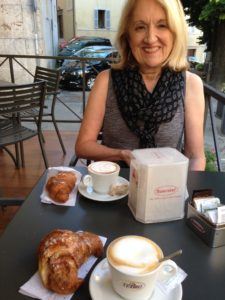
Helps, though, if the photojournalist is awake enough to save the crop of hair.
03 Saturday Sep 2016
Or, “Clueless, Just Take the Euro!”
Eurospin Giveaway, apparently, works this way: a certain supermarket customer, randomly passing through the checkout line, is offered an immersion blender for a Euro.
When U have an uncertain Italian student, who is basically flunking out, the whole transaction goes to pot: first, the clerk tries her hand in Italian; then, a customer in broken English takes a spin.
Finally, in mock-exasperation, she exclaims “Just take the Euro!” The one, apparently, she has been trying to hand me, lord knows why, for some time.
And with that financial exchange, apparently, the conversational exchange is completed.
“Do you know what just happened?” Reb asks as we are leaving the store. “Of course not,” I reply in my best student voice.
Only when we get home and read the printed receipt does the clue finally arrive: “Frullatore ad immer” (1,00 Euro) is printed out below the “Subtotale.” In other words, the immersion blender was at the bottom of this language lesson all the time.
03 Saturday Sep 2016
Posted in Education
“Dementico,” naturally, means “I forgot.” For us the aged, though, that cuts too close to the bone.
“Non recordo,” in the course of things, means almost the same thing: “I do not remember.”
Tenses, however, are tougher. As I learned, in applying Reb’s lesson, when forgetting about the future.
My solution: stick to what you know, using hand gestures to signal backwards or forwards.
Reb laughs at the joke, while flunking me on Language Lesson 2.0.
01 Thursday Sep 2016
Posted in Education, Uncategorized
Perché = why
Perché = because
The reason why is because of any reason that remains intact in school?
29 Monday Aug 2016
Posted in Education
Two years ago, performing the ritual sightseeing trip to Norcia, we were awed by the mountains and the plain of Castelluccio. And I was drawn to the quaint little town, which seemed to circle around an unreachable center, in what struck me as of a piece with the non-Euclidean universe I kept finding in these hill towns.
With camera in hand, as every self-respecting tourist insists on burdening himself (and others?), I added to the collection of my door series. But I was especially fixated, as I now remember, on a construction site in Castelluccio that we passed by on the first leg of our journey up the hill.
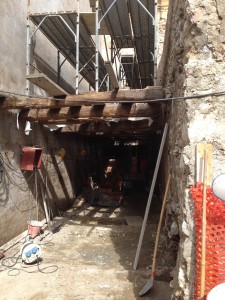
Little did I know. This wasn’t just your ordinary episode on the HGTV network. Engaged in what passes for research these days (i.e., surfing on the Internet), I stumble upon the rubble of our ignorance: back in 2014, just before we visited, an earthquake brought down some buildings in this lovely mountain town Continue reading »
29 Monday Aug 2016
Posted in Education
What are the odds? In Probability 101, the expected break-even answer always assumes a perfectly balanced coin and the ideal atmospheric state. Meanwhile, back here in the real world, neither the coins nor the geopolitical advantages are evenly distributed.
Spoleto, our cherished home-away-from-home, is among the lucky ones. Being twenty miles from the epicenter of the recent earthquake surely helps. So too, however, the advantages of wealth: literally building on its cultural cachet, over the years, the town has reinforced ancient buildings with earthquake-resistant infrastructures.
The smaller villages and towns in the mountainous areas, like Amatrice and Castelluccio, are significantly worlds apart. (Italy has an estimated 20,000 semi-abandoned villages, I have just found out. After World War II, the locals often departed in search of a better life. And while some later returned to their homes, they typically settled for a summer retreat.)
The town of Accumoli, for example, has about 600 permanent residents; while in the summer, the tiny population soars into the thousands. Castelluccio, much smaller in size, follows the same basic pattern for quite different reasons (harsh winters and the seasonal rhythms of agricultural production keep folk away).
Just as in the States, for the rest of the summer our future holds a tale of two types of towns–one relatively safe, teeming with life, and wealth; the other, remote, tragically devastated, and perpetually poor. As in this scene, captured on film, at two points in time.


20 Tuesday Oct 2015
Posted in Education
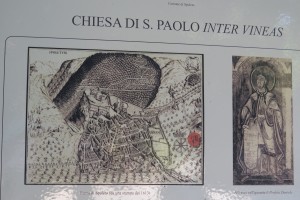
The saint narrates of an Arian bishop who, having dared to celebrate mass, was stricken by sudden blindness. From this moment the church became the object of numerous reconstructions and changes in use.
In the 10th century it became a Benedictine convent. The church was rebuilt in the style of mature Spoleto Romanesque and was consecrated in 1234 by Gregory IX, while the nuns embraced the Rule of the Clarises.
During the 16th century the clashes between the city factions led to the closing of the convent, which in the following century was ceded to the Lesser Observants.
Entrusted to this order until the 19th century, it was then turned into a refuge for beggars.
The work done in the 18th century transformed the building inside and outside: the present look is the result of the restoration done in the middle of the sixties, which restored its late Romanesque character.
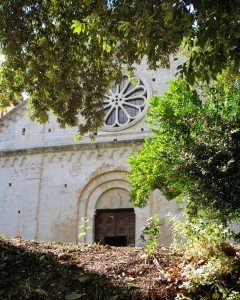
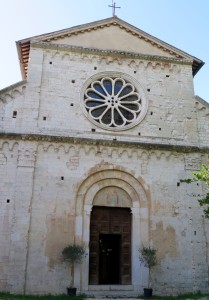
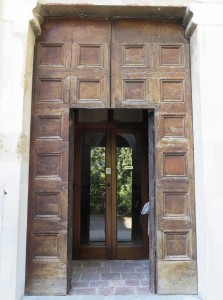
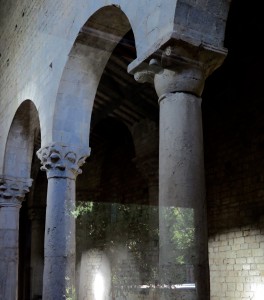
The façade with two slopes and central raising divided by pilasters with Corinthian capitals and dividing cornices on small hanging arches, has an arched portal with three insets and a rose window constituted by old elements.
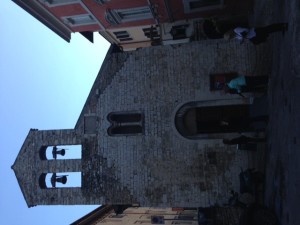
[The façade is now defaced with graffiti, as eventually to be shown below. Civic prose is likewise to be retraced with hyperlinks, all in good time.]
The interior, which has a nave and two side aisles and a big transcept, is divided into six parts. Worthy of note is the cycle of frescoes from the beginning of the 13th century, an important testimony to the figurative culture of southern Umbria: they were detached in 1953 and replaced after the latest restoration (2011), and depict scenes from the Old Testament.
20 Tuesday Oct 2015
Posted in Education
When you go looking for the loggia next door, this is what you get:
06 Tuesday Oct 2015
Posted in Education
1. T/F I was delighted to find a printed program for the Pegasus Concerti.
2. T/F I was pretty sure the Schumann variation had arrived on schedule.
After that, it was essentially multiple-guess all the way down the line. It helped, of course, that only three piano instrumentals were planned; not to mention, the limited appearance of women performers. Throw in a distinguishing rendition in German and then French to go with the Italian numbers; account for repeat performances by pianist or vocalist; and before you know it (in retrospect) the program sorts itself out (once one soprano’s non-appearance is factored in.)
Terrific performances. Gratefully received by a enthusiastic crowd. Fully expect that we will be going back to enjoy ourselves some more.
06 Tuesday Oct 2015
Posted in Education
“Hurry up” the hill, I tell Rebecca, on the way to Pegasus concert.
“What’s your hurry?” (or something like that), the guardians ask.