Behind S. Nicolo, where we heard “Hey Joe,” night falls on the hillside.
After the Opera
12 Monday Sep 2016
Posted in Art

12 Monday Sep 2016
Posted in Art
Behind S. Nicolo, where we heard “Hey Joe,” night falls on the hillside.

11 Sunday Sep 2016
Posted in Art
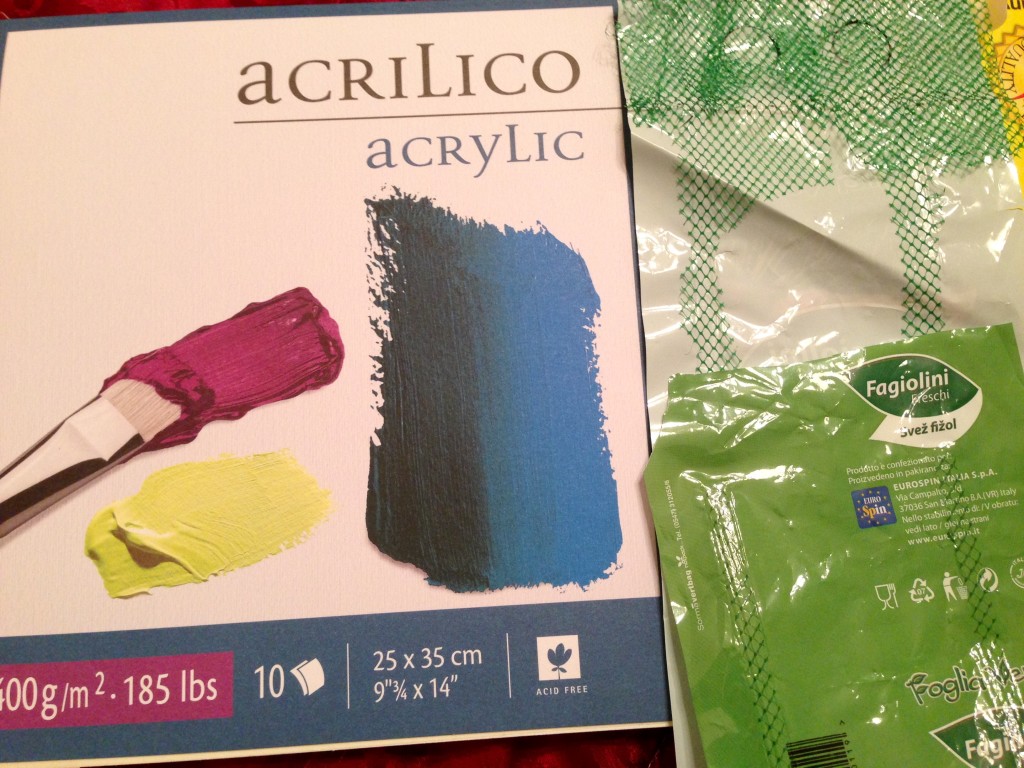
Around here, the food we buy gets eaten. Nothing special there.
But what we buy (or its containers anyway) gets re-purposed by the artist.
11 Sunday Sep 2016
Posted in Art
Artists, we find, see colors and lines;
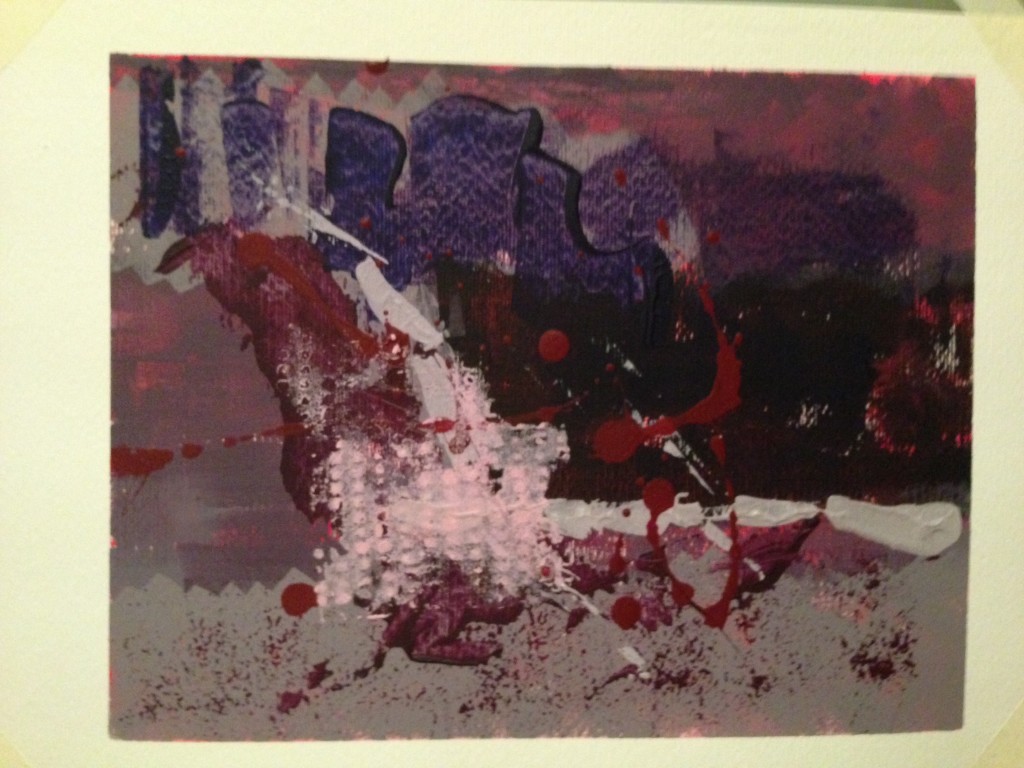
while writers hear rhythms and rhymes.
09 Friday Sep 2016
Midway through our education at the Instiuto Modigliani, a group of some sort (led by an instructor of some sort) descended upon the exhibit.
At first, we thought there might be a way to maneuver between the several rooms, keeping breathing space between us, without losing track of our goal.
Eventually, we had no choice but to share a small room, where the few actual originals were kept. Navigating those confines, somehow, seemed to be working.
Then a dapper young man, with a scarf, approached Rebecca. (He must have known about her scarf collection, even if he mistook her for a native Italian.)
The gentleman did a fine job holding up both ends of whatever conversation we were having about the process of restoring the canvas displayed before us.
Addressing his remarks to the obvious artist among us, he grew rather animated in his analysis of the painting that had been singled out for display.
Perhaps it would have helped if we could have read the one sign presented to the museum goers in Italian only. He, obviously, thought we could manage.
The way things stood, when he finally took his gracious leave of us, almost said it all. I glanced quizzically at Rebecca (to which she replied), “Not a clue.”
08 Thursday Sep 2016
Forget Judy Collins (and Crosby, Stills, and Nash). All that was serious enough, in its way.
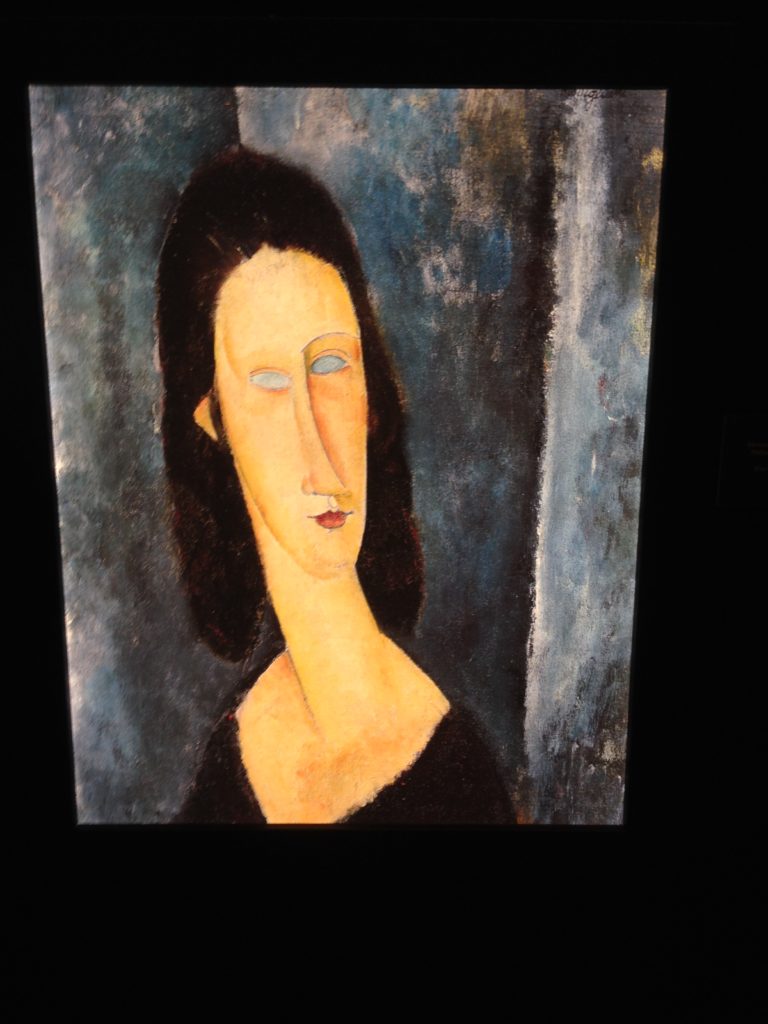
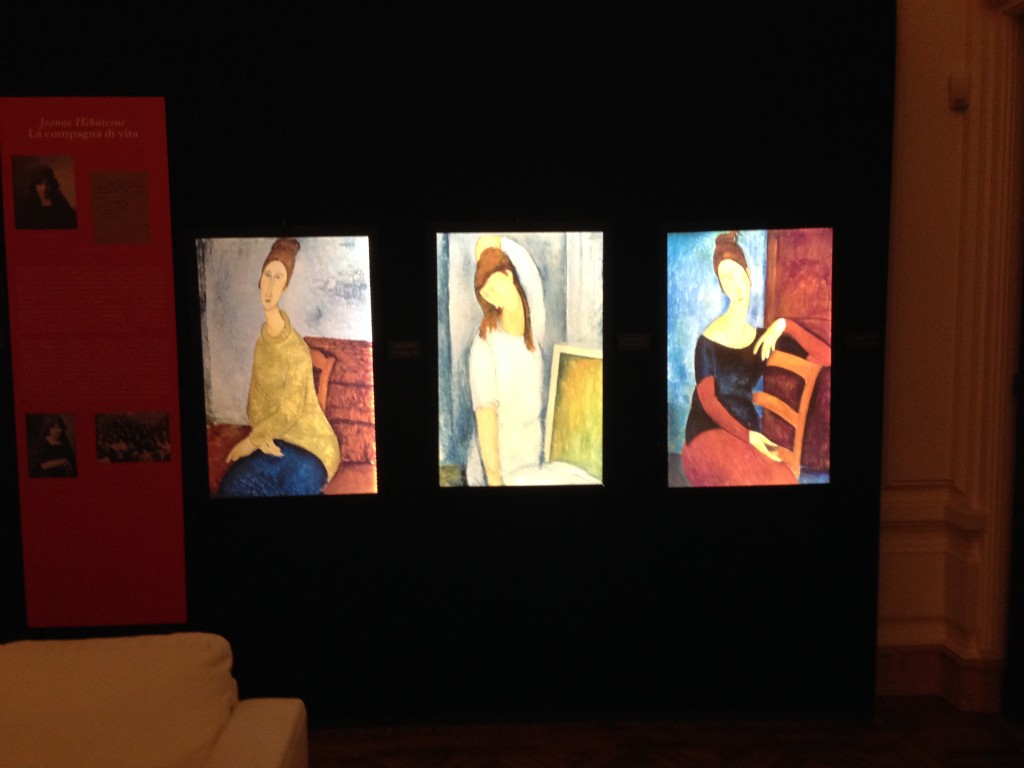
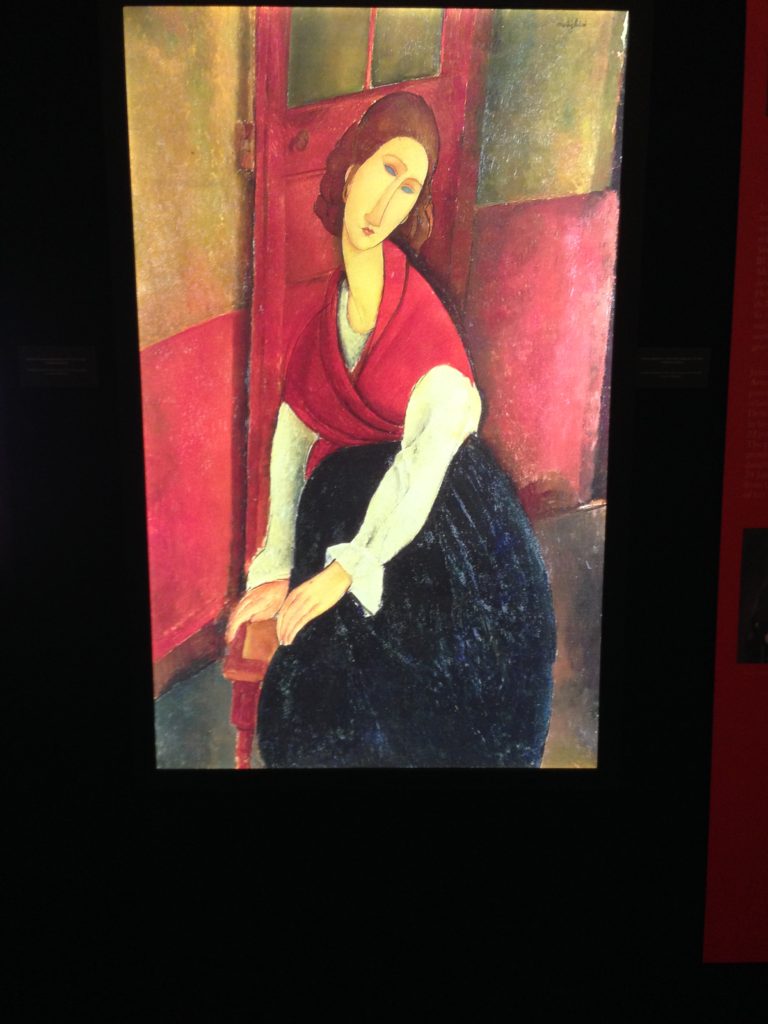
But if U want the epitome of the tragic artist(s), it’s hard to beat the story of Amedeo Modigliani and Jeanne Hébuterne.
Much too convoluted, and fascinating, to shorten here. The video alone, which we watched yesterday in advance of the exhibit, ran about twenty minutes.
Perhaps these replicas, or the Collins parallels, will entice.
03 Saturday Sep 2016
William Shakespeare’s Sonnet 130 mocks the conventions of the showy and flowery courtly sonnets in its realistic portrayal of his mistress.
My mistress’ eyes are nothing like the sun;
Coral is far more red than her lips’ red:
If snow be white, why then her breasts are dun;
If hairs be wires, black wires grow on her head.
I have seen roses damask’d, red and white,
But no such roses see I in her cheeks;
And in some perfumes is there more delight
Than in the breath that from my mistress reeks.
I love to hear her speak, yet well I know
That music hath a far more pleasing sound:
I grant I never saw a goddess go,
My mistress, when she walks, treads on the ground:
And yet, by heaven, I think my love as rare
As any she belied with false compare.
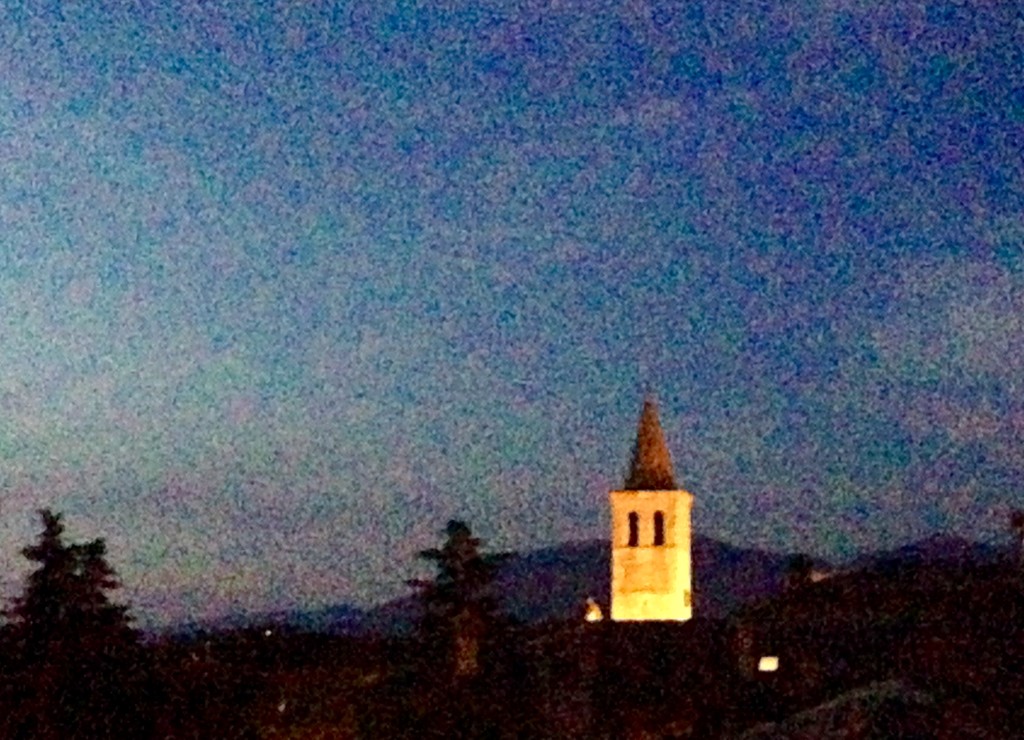
My photograph, straining against the limitations of its taker (or lens), isn’t exactly mocking the realistic conventions of the medium. But it does look sort of painterly, as even my artist wife might admit.
Whether any of that means anything, much less makes it art, only explains perhaps why the allusion popped into my head. I just thought it (the title) was funny, and (it, the image) looked “pretty.”
19 Monday Oct 2015
Posted in Art
04 Sunday Oct 2015
Posted in Art
Two different views of the garden, on an earlier day’s outing, from above:
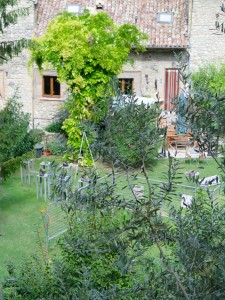
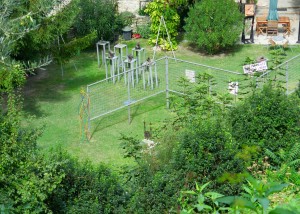
The widest angle, by far, on the house. Of note from an earlier post: to enter the garden, you step right off the walk beside the Roman wall (Via Mura Ciclopiche).
04 Sunday Oct 2015
Venture down the steps below the Duomo to feel the magic of an unusual and enchanting garden surrounded by medieval houses. There is a likely chance you will meet the artist. It surely will be a highlight of your visit to Spoleto.
Unsure who wrote these words, sitting invitingly on the flip side of the Open Art Spoleto brochure. But they capture the feeling we’ve had each time we visited.
With one exception: the chance of finding it open, much less meeting the artist, never seemed all that likely. (Many photographs we have, certainly, from afar.)
This year, all that changed. After pulling on the locked gate, hearing the hidden dog bark, we turned to leave … before an English-speaking Italian appeared.
He fumbled through a set of keys; joked about the last one holding the charm; then ushered us into a truly enchanting garden surrounded by medieval houses.
The brochure forgot to mention all the art works, spread throughout the garden, in the open air. Small sculptures, mostly figures and faces, hanging everywhere.
Some of these photos online, from a garden party, come close to the feel (if you subtract the important-looking people and flip the setting from night to day).
Predictably, neither the brochure nor the website carries any of the delight of the conversation. Born in Spoleto, Giampiero Panella returned home ten years ago.
He lives and works in this fabulous old house, realizing the human form in terra-cotta figures, then converted to bronze before being placed in a garden setting.
<The Machine in the Garden is an old book of mine. After my fall from grace with technology, I fear promises. If some of the pixels turn out, you’ll see.>
03 Saturday Oct 2015
Thanks to Wikipedia, I had the plot to La Boheme down cold. None of us, however, were prepared for the heat in the Teatro Nuovo. (Except for the self-proclaimed “crazy Italian” who pulls off his shirt–before, or as, the performance begins–to reveal a fairly heavy undershirt, which he restrained from shedding as well. All good fun, shared in a mix of English and Italian that grows familiar.)
But with the Wi-Fi high jinks, I could never prepare for the arias themselves. So there was the music, the scenery, and the crowd. Plus the voices, so amazing to be so young. (The performances are part of a 69-year old tradition of training new talent. Quite a feat for a town this small. And one that sustains itself, I would think, by the many days where the program is performed for the schools.)
